Comfortable sandals with anatomical soles have dominated the women’s summer market for several years. Their success is based on a simple principle: a cork or latex sole that conforms to the arch of the foot and absorbs shocks with every step. Finding models that combine this comfort with a more feminine and dressed-up look remains a delicate task, as most online lists simply recycle the same sports or orthopedic references.
Anatomical sole and femininity: what the foot really demands
The comfort of a sandal relies on three technical elements that are non-negotiable: arch support, heel cushioning, and lateral stability. Without these three points, a flat sandal tires the foot after just a few hours, regardless of its price.
An anatomical preformed sole distributes the body’s weight across the entire surface of the foot instead of concentrating pressure on the heel and forefoot. Brands offering this type of sole are no longer limited to sports models. El Naturalista, for example, frequently appears in Facebook groups of users for its anatomical sole sandals, whose design clearly deviates from hiking styles.
Looking for an alternative to Birkenstock for women means checking that the insole provides a comparable arch shape, not just a flat cushion covered with soft leather.
Materials that make a difference
Soft lined leather remains the material that best adapts to the foot’s morphology over time. Genuine leather straps stretch slightly to conform to the shape without causing friction, while rigid synthetic materials can cause blisters from the very first long walk.
Some ethical European brands also use soles made from recycled natural rubber, which are lighter than traditional cork and sufficiently flexible to cushion urban cobblestones. The choice of the outer sole material is just as important as that of the insole: a sole that is too hard transmits every irregularity of the ground directly to the foot.

Women’s sandals tested over long distances: real user feedback
Product sheets all claim “exceptional comfort.” User feedback after several days of walking while traveling or during intensive urban days tells a more nuanced story.
In online communities, Geox frequently comes up as a city solution worn during city trips. Users report superior breathability thanks to the patented perforated sole, a concrete advantage when temperatures exceed thirty degrees during hours of walking.
El Naturalista, on the other hand, receives positive reviews regarding durability and support after several seasons of daily use. Its dressier look, with curved lines and natural shades, allows it to be worn with a dress without giving the impression of wearing technical equipment.
Criteria that stand out after several thousand steps
- The weight of the sandal: beyond a certain threshold, every extra gram is felt at the end of the day, especially on models with thick cork soles
- The height of the back counter: a heel strap that is too low slips and forces the toes to cramp to hold the shoe, which tires the entire muscle chain
- The flexibility of the sole at the forefoot: a sole that doesn’t bend in the right place alters the stride and causes knee pain after a few hours
- The grip of the outer sole on wet ground: a criterion often overlooked in product sheets but regularly mentioned in feedback from travelers
Closed summer sandals: the avenue that comfort lists ignore
A rarely addressed angle in comparisons of comfortable sandals concerns closed summer shoes. Structured slingbacks, closed-toe mules, and certain airy ballerinas offer the same level of ventilation as an open sandal, often with superior support.
This category meets a real need: not all women want to wear an open model, whether for aesthetic preference or professional constraints. A closed perforated leather mule with a latex sole provides comfort comparable to that of an anatomical sandal while remaining compatible with a semi-formal dress code.
The gain in support is subjectively measurable from the first hours: the foot does not slide forward, the toes do not cramp, and the gait remains natural. For days that combine walking and prolonged standing, a well-arched closed mule often surpasses a flat flip-flop, even an “anatomical” one.
Selection criteria for comfortable and stylish sandals for everyday wear
The market offers dozens of models that claim comfort. Effectively filtering requires prioritizing criteria rather than checking all the boxes.
- Prioritize the shape of the insole over the thickness of the cushioning: well-placed arch support tires the foot less than a very thick but flat sole
- Check that the straps are adjustable (buckle, velcro, elastic) to adjust the tightness throughout the day, as the foot naturally swells with heat
- Test the torsion of the sole by hand before purchase: a sole that twists too easily does not provide enough lateral stability for prolonged walking
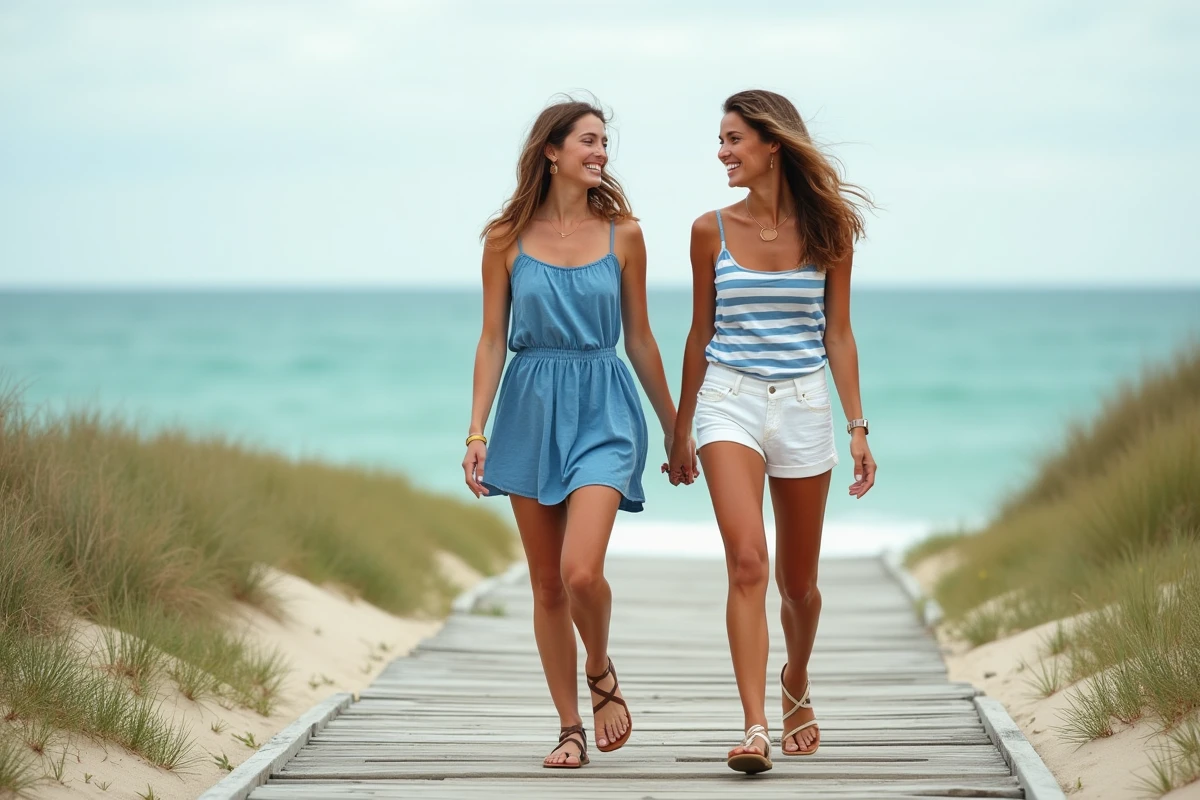
Style comes into play once these technical criteria are met. Neutral shades (camel, black, cognac) in smooth or textured leather pair well with both a summer dress and jeans. Models with thin straps and a block heel of a few centimeters add a dressed-up touch without sacrificing stability.
The trend of flat sandals with crossed straps also allows for a compromise between minimalist look and support. The crossing of the straps over the top of the foot distributes tension and limits pressure points, provided the leather is soft enough from the first wear.
The choice of a pair of feminine and comfortable sandals is made based on the compatibility between the foot’s morphology and the technical construction of the model. User feedback in real conditions, accessible on dedicated forums and groups, remains the most reliable source for distinguishing between two models with identical product sheets.