
Ear stretchers concentrate a rarely articulated tension in the world of body jewelry: they are simultaneously one of humanity’s oldest ornaments and a fashion accessory whose popularity is exploding on social media. Measuring the gap between these two realities is to understand how a millennia-old ritual gesture has transformed into an aesthetic practice framed by European health standards.
Tribal stretcher and contemporary stretcher: what the same word encompasses
The term “stretcher” today refers to at least three distinct objects, and this confusion fuels some misunderstandings about their use. It is necessary to separate the gradual widening of a healed piercing, the conical jewelry (taper) used to increase the diameter of the lobe, and the decorative plug worn once the desired diameter is reached.
In traditional societies of East Africa or South America, lobe widening served as a social marker: a rite of passage to adulthood, status within the group, clan affiliation. The material (wood, bone, stone) and the diameter carried a coded meaning, readable by community members.
Today, the majority of wearers choose a stretcher for purely aesthetic reasons. The material is often surgical (titanium, implant-grade steel, borosilicate glass) and the diameter is a personal choice, without a shared cultural framework. To discover Murano Bijoux and their analysis of this transition, the parallel between ritual function and decorative function is documented in detail.

Materials and health standards: comparative table between ancestral practices and current standards
Tribal practices and modern protocols do not share the same materials or hygiene constraints. The European standard NF EN 17169 (2020) now governs asepsis, equipment, and the organization of the act for professional tattooing and piercing.
| Criterion | Traditional tribal practice | Regulated contemporary practice |
|---|---|---|
| Materials | Wood, bone, horn, clay, stone | Implant-grade titanium, borosilicate glass, surgical steel |
| Asepsis | Cultural-specific purification rituals | Sterile protocol compliant with NF EN 17169 |
| Practitioner training | Oral transmission, community initiation | Mandatory hygiene training, prevention of blood exposure accidents |
| Management of complications | Local pharmacopoeia (plants, poultices) | Medical referral, downsizing, antiseptic care |
| Meaning of the act | Rite of passage, coded social marker | Individual aesthetic expression |
This table makes visible a fundamental shift: responsibility has shifted from the community to the individual practitioner. In a tribal context, the group framed the process and its aftermath. In a contemporary studio, it is the trained piercer who assumes health compliance and post-procedure follow-up.
Risks of self-stretching: what popularization does not show
The democratization of stretchers has a documented downside. Self-stretching, practiced at home with non-professional equipment, remains a frequent source of complications. Contemporary professional training emphasizes preparation of the workspace and prevention of blood exposure accidents, but these precautions only concern studios by definition.
The most common risks associated with poorly conducted stretching are specific:
- Lobe tear (blowout) when the diameter is increased too quickly, without respecting healing stages between sizes
- Local infection due to porous material (untreated wood, low-grade acrylic) or insufficient hygiene during handling
- Keloid scarring in predisposed individuals, exacerbated by chronic irritation from an unsuitable piece of jewelry
- Irreversible loss of elasticity beyond a certain diameter, making a return to the initial lobe impossible without reconstructive surgery
Professionalization shifts the debate from aesthetics to safety. Online content often presents the stretcher as a mere style accessory. In contrast, training organizations like IFEP incorporate stretching into a broader framework of biological risk management.
Cultural appropriation and stretchers: a tension that structures the market
The contemporary stretcher borrows a form from cultures where it held a specific meaning. This trajectory is not unique to stretchers (tattooing has followed a similar path), but it takes on a particular dimension here because the physical act remains the same while its meaning has been entirely emptied and then reconstructed.
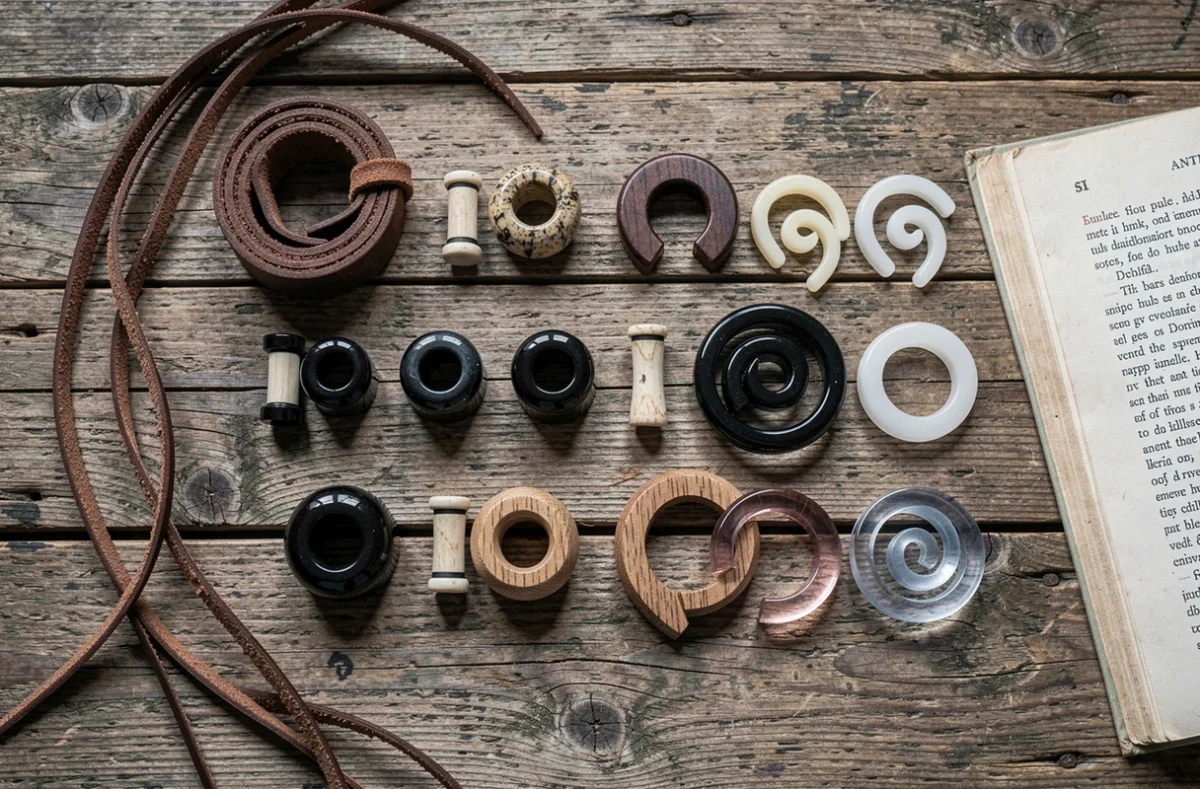
The current market does not distinguish between a silicone plug sold as a festival accessory and an ebony stretcher made using traditional African techniques. Both coexist on the same sales platforms. This commercial indistinction fuels an ongoing debate in body modification communities, without a consensus emerging.
What is measurable, however, is the price gap. Handmade stretchers made from natural materials, crafted by artisans who claim a cultural lineage, are positioned in a significantly higher segment than industrial acrylic plugs. Price becomes a marker of cultural positioning as much as material quality.
Stretching and professional piercing: the criteria that separate a safe act from an avoidable risk
The NF EN 17169 standard does not explicitly mention stretching as a distinct act, but the principles it establishes apply directly: sterilization of equipment, traceability of jewelry, informing the client about the aftermath and risks. A compliant studio applies these rules to stretching just as it does to any other piercing.
The concrete criteria for evaluating a practitioner are as follows:
- Up-to-date hygiene and sanitation training certificate, including prevention of blood exposure accidents
- Exclusive use of implant-grade materials for active widening phases
- Documented downsizing protocol in case of complication (temporary reduction of diameter to allow healing)
A stretcher worn in a healthy lobe, gradually widened by a trained professional, with compliant materials, poses no more risks than a standard piercing. It is the context of the act, not the object itself, that determines the level of risk.
The stretcher remains a hybrid object, at the crossroads of anthropological memory and a globalized body jewelry market. The most revealing data of this mutation may lie in the standard itself: by codifying the hygiene of stretching on par with that of piercing, European regulation confirms that the stretcher has definitively left the realm of ritual to enter that of regulated aesthetic care.