You just found a condo in Bangkok on Facebook, the price is attractive, the photos are stunning, and the owner is asking you to transfer two months’ deposit even before the visit. This scenario traps dozens of tenants every year. Avoiding scams when renting in Bangkok relies less on distrust and more on understanding a few specific legal and practical mechanisms that effectively protect a foreign tenant.
Overcharging for utilities in Bangkok: the most reliable warning sign
Before even discussing fake landlords or dubious contracts, one indicator often goes unnoticed: the electricity and water bill. In many condos and apartments rented in Bangkok, the landlord charges these utilities at a rate higher than that of the public provider.
Why has this point become a legal benchmark? For landlords operating multiple rental units and subject to the updated Thai regulatory regime, the charges cannot exceed the rates charged by public utilities. A landlord who asks for double the actual electricity rate is violating this rule, and this often reveals other abusive practices in the contract.
Before signing, ask to see the original water and electricity bills, or at least the calculation method applied. A landlord who refuses this transparency gives you a concrete reason to look elsewhere. This simple reflex filters out a good portion of problematic rentals in Bangkok.
To delve deeper into the risks associated with renting in the Thai capital, you can rent in Bangkok on the Sur Le Toit website, which details common pitfalls and possible remedies.
Security deposit and advance rent: the legal ceiling that listings ignore
A listing requiring six months of initial payment should trigger a verification reflex, not negotiation. According to the regime applicable to landlords operating multiple rental units, the security deposit and advance rent are capped together at three months’ rent.
This rule does not automatically apply to a private landlord renting only one property. The distinction is important: before contesting an amount, check the exact status of the landlord. The Office of the Consumer Protection Board (OCPB) can guide you on this point.
What the contract must contain
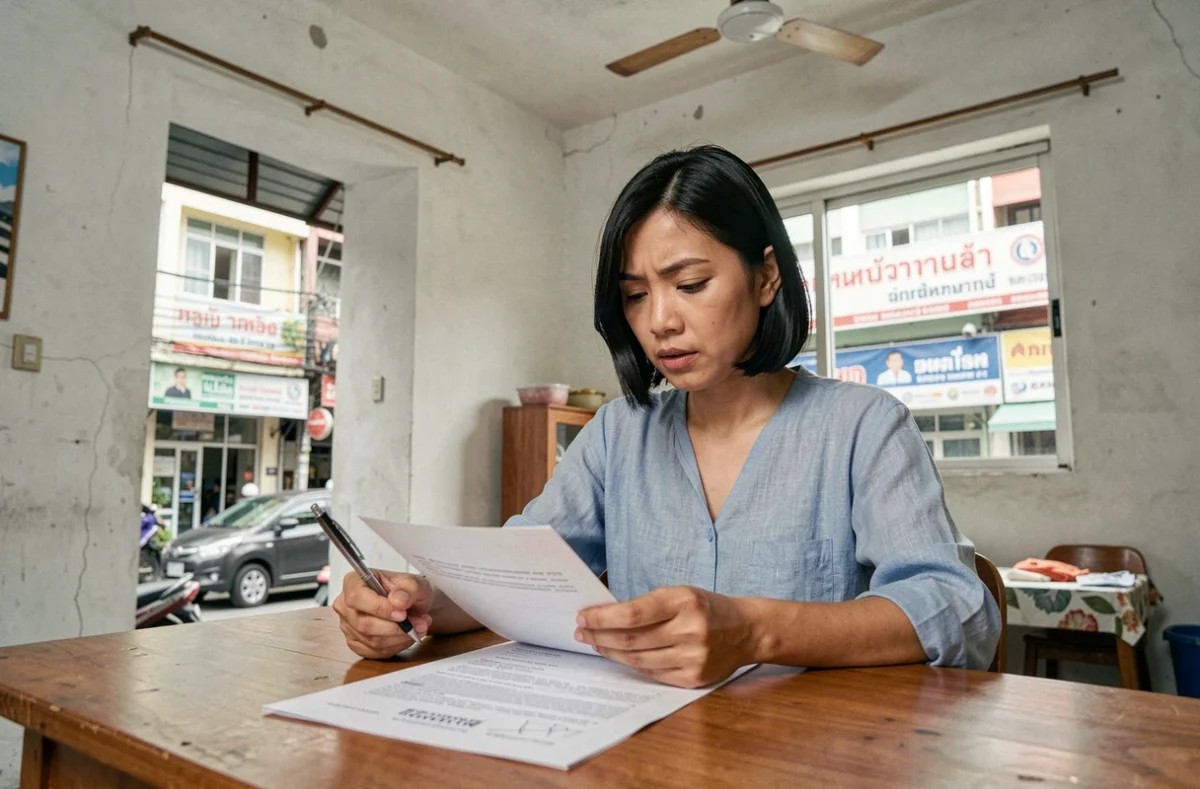
For landlords subject to this regime, the contract must follow a regulatory model and be provided in two copies. No clause can remove the legal protections of the tenant. If the document handed to you is a simple sheet in Thai without translation, without mention of the deposit or the terms of return, you are facing an incomplete contract.
- Check that the contract mentions the exact amount of the deposit and the deadline for its return after departure.
- Request a bilingual copy (Thai-English at minimum) signed by both parties.
- Refuse to pay in cash: a bank transfer generates a timestamped proof of payment.
A timeline for the return of the deposit must be explicitly stated in the lease. Without this mention, recovering your money after departure becomes a tug-of-war without legal leverage.
Fake landlords and online listings: verify the landlord’s identity
Fraudulent listings on Facebook Marketplace or expatriate groups in Bangkok follow a recurring pattern: prices significantly below market, professional photos taken from another site, and a request for a deposit before any visit. The tenant pays, and the “landlord” disappears.
How can you verify that the person in front of you is indeed the owner of the property? In Thailand, the title deed of a condo is called the Chanote. Ask to see the Chanote and compare the name with the landlord’s ID. For a condo, this verification can also be done at the legal office of the condominium.
Short-term rentals in a residential condo
A particular case deserves attention: “Airbnb-style” offers in a residential building. A daily rental in a residential condominium in Bangkok poses a distinct legal risk. Many condominiums prohibit rentals of less than 30 days in their internal regulations.
If you sign a short-term lease in a building that prohibits it, you can be evicted without recourse. Check the minimum duration allowed by the condominium’s regulations before committing, even if the listing seems perfectly legitimate.
Concrete reflexes before signing a lease in Bangkok
A physical visit to the property remains the most effective protection. No photo, no video tour can replace the experience of seeing the actual condition of the premises, testing the plumbing, checking the lock, and meeting the building’s caretaker.
- Photograph each room and each defect on the day of the inventory, then email these photos to the landlord to create a dated record.
- Ask the condominium’s legal advisor to confirm the owner’s identity and the authorization to rent.
- Beware of a landlord who categorically refuses a visit or who imposes payment before your arrival in Thailand.
- Consult the OCPB if you have doubts about the landlord’s regulatory status or about a clause in the contract.
Most rental scams in Bangkok exploit urgency and distance. A serious landlord will accept that you take the time to verify the Chanote, read the bilingual contract, and visit the property. Those who rush you to pay before these steps give you, unwittingly, the best signal to walk away.