
Every month, millions of payslips no longer arrive in the mail. Instead, they land in an online space linked to the employee, not the company. Arkevia is one such space: a secure digital vault provided by Cegedim SRH and integrated with the provider’s payroll and HR services. Its main purpose is to receive, store and retrieve digital payslips, as well as other sensitive documents related to working life.
One point that is often overlooked: the use of a digital vault is not required by law. The French Labour Code (Article L. 3243-2) requires employers to ensure the integrity, availability and confidentiality of electronic payslips, but does not prescribe a specific tool. Arkevia is therefore a company’s choice, not a legal requirement.
Employees’ right to object to electronic payslips
Are you receiving your payslips through Arkevia without having requested it? That’s normal: employers can choose electronic delivery by default. However, employees can refuse this delivery method at any time, even after initially accepting it.
Article D. 3243-7 of the French Labour Code states that employers must inform employees of their right to object before issuing the first electronic payslip or when they are hired. If an employee subsequently objects, paper payslips must be reinstated no later than three months after notification. This gives the payroll department time to adapt its distribution process.
An article explaining how Arkevia works on Travailler chez soi covers the practical steps for activating and navigating the personal account.
In practice, few employees exercise this right because they don’t know it exists. Checking this information before contacting HR can save an unnecessary exchange.

Storing payslips on Arkevia: retention periods and actual limitations
Arkevia’s promise, echoed in most online descriptions, comes down to one figure: a very long retention period. The French Labour Code (Article D. 3243-8) states that payslips remain available for 50 years or until the employee turns 75 (the legal reference age plus six years).
This guarantee applies to payslips deposited by the employer through the legally prescribed process. It does not automatically cover personal documents that an employee adds to their account. This distinction matters: an employment contract scanned or a France Travail certificate voluntarily stored in the vault may not be covered by the same regulatory framework.
What the legal framework protects—and what it doesn’t
- Payslips deposited by the employer are covered by the long-term availability requirement set out in the French Labour Code.
- Documents added manually by the employee are subject to the provider’s terms and conditions, not the French Labour Code.
- In the event of a dispute, only a payslip timestamped and sealed by the system is guaranteed to have evidentiary value. A PDF manually uploaded to the vault does not have the same status.
Before treating Arkevia as a universal archive, it’s best to read the terms of use and check which documents are actually covered for the long term.
Changing providers or closing the service: retrieving your documents
Your employer decides to leave Cegedim SRH for another payroll provider. What happens to your payslips stored on Arkevia? This is the most practical question—and the one least often addressed.
The French Labour Code requires at least three months’ notice before the service is discontinued (Article D. 3243-8). During this period, employees must be able to retrieve all their payslips in a standard, commonly used electronic format, without complex or repetitive steps.
In practice, this means being able to download payslips in bulk as PDFs or in an equivalent format. The provider cannot require employees to retrieve them one by one or use specific software to read the files.
Who to contact in different situations
Since Arkevia is linked to Cegedim SRH’s payroll services, the employer manages account activation and document delivery. If you have trouble accessing your account, your first point of contact should be your company’s HR or payroll department, not Cegedim directly.
If your employer has already switched to another provider, things become more complicated. You’ll need to contact the former provider during the notice period. After that, your options depend on the contractual commitments between the company and Cegedim SRH, to which you are not a party.
- During the service closure notice period: download all your payslips from your My Arkevia account (myarkevia.com).
- After changing employers: the vault remains accessible using your personal login details, independently of your link to the company.
- If your account is blocked: first contact the HR department of your current employer or the last employer that activated the vault.
- If the provider ceases operations: exercise your right to retrieve your documents within three months of notification.
Arkevia vault security: what actually protects your data
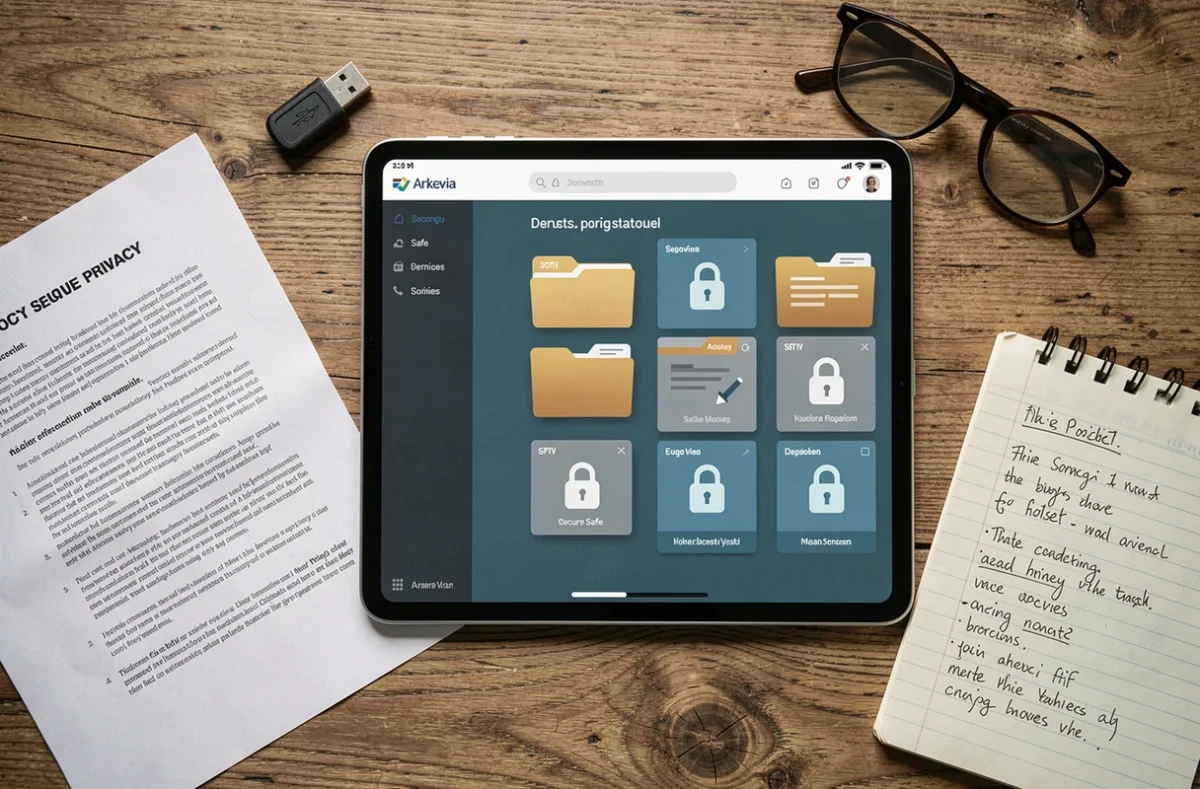
Overview pages often mention encryption and GDPR compliance without explaining what they mean in practice. The AES-256 encryption used by Arkevia means that each document is unreadable without the decryption key, both while stored and during transfer.
GDPR compliance requires data to be hosted under traceable conditions and gives employees the right to access, rectify and erase their data. However, the GDPR does not certify a particular level of technical security: it governs how personal data is processed.
Timestamps and evidentiary value
When an employer submits a payslip through Arkevia, the document is timestamped and electronically sealed. This process fixes its contents at a specific point in time. In the event of a challenge—such as an incorrect amount or an employment tribunal dispute—the timestamped payslip can be admitted as evidence in court, provided the sealing process complies with the applicable standards.
This seal sets Arkevia apart from ordinary cloud storage. A file uploaded to Google Drive or Dropbox has no built-in evidentiary value: you would have to prove separately that it had not been altered.
Arkevia’s digital vault does its job as long as employees understand its limitations: legal protection applies to payslips, not every document, and retrieval is possible provided you act within the time limits set by the French Labour Code. The best precaution is still to regularly download a local copy of your payslips, whether or not you use a digital vault.